Gain insights into grant writing efficiency by learning from professional grant writers. Discover how long it takes others to find grants and valuable tips to improve your own process.

TOPIC
AUDIENCE
If you’re a grant professional, you’ve probably found yourself wondering before: “How long does it take other people to find grants? Am I taking too long? Or, should I be taking longer?”
Listen—you’re not alone! And you’re definitely in the right place.
We surveyed grant writers, and we asked them these exact questions.
Keep reading to hear what other professional grant writers have to say, as well as some tips and tricks to help improve your grant writing efficiency.
Let’s go!
Whether you’re a seasoned grant writer or brand new, finding good-fit funders can be a time-consuming and frustrating process.
Instrumentl talked to grant professionals about their experiences conducting prospect research and how much time it takes them to identify good-fit funders. Here’s what we asked:
When pursuing grants, how long does it take for you to find 5 good fit funders to apply for?
The table above outlines the responses from the grant professionals that Instrumentl surveyed.

20% of the writers surveyed said that it takes them 12 or more days to compile a list of 5 good fit funders. That’s a really long time! Yikes!
Only 3 respondents shared that they are able to find a list of 5 good fit funding matches in less than 1 day; and 14 respondents (31%) shared that they’re able to achieve this in 1-3 days.
The responses in the chart above are quite varied. Some grant professionals zip through their prospect research in less than a day, while others are spending weeks trying to find good fit funding opportunities.
The reason for this variation comes down to a few things:
Here’s the bottom line: prospect research is a critical part of the grant seeking process. But you need to be able to do it efficiently. Keep reading and we’ll tell you how!
Using the right tools and strategies can be a game-changer in terms of making your grant prospecting more streamlined and effective.
Veronica Kulon, grant professional and nonprofit consultant, shares her advice for finding good-fit funders efficiently:
“Prioritize efforts based on potential impact, use search filters aligned with your mission, and consider collaborating with team members or volunteers to distribute the workload efficiently.”
We love these words of wisdom. Let’s break down each one of her tips in more detail.
When you’re exploring grant opportunities, it’s important to make sure that the funding aligns with your organization’s needs.
Once you have a list of potential grants, we recommend prioritizing those with the opportunity for the most impact. AKA: the opportunities that offer large or even multi-year funding awards. In this case, more is better!
Instrumentl can help you evaluate and prioritize different funders with their Key Financial Stats breakdowns! You can assess a funder’s giving averages, medians, number of awards, and more with a simple click of a button!
These detailed financial snapshots make it easy for you to prioritize grants with the highest potential impact.
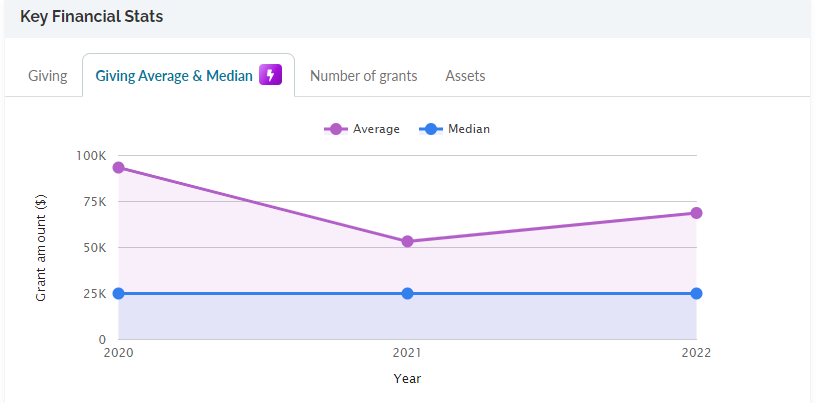
Making sure a funder is aligned with your mission and your area of work is key.
How do you do this? Use search filters to specify exactly what you’re looking for. This can be tough to do in internet searches or with some grant search tools. However, Instrumentl makes this super easy!

Using Instrumentl, you can input keywords to search for and narrow down opportunities based on your project and/or focus area. Right out of the gate, this will eliminate any irrelevant funders or opportunities from your list, making sure you only see those who are a match. You’re already saving time!
And once you’ve found a funding opportunity within Instrumentl, you can also check out the funder's giving history, specifically the causes and NTEE codes that they’ve supported the most in the past.

Collaborate With Team Members
Finding good-fit funding opportunities can be a time-consuming process. Conducting prospect research, vetting opportunities, reaching out to potential funders, building relationships—it takes a lot of work!
One way to create efficiency in this process is through collaboration. By delegating tasks and splitting up the workload, you can accomplish more as a team.
However, this type of collaboration requires everyone to be on the same page and stay aware of their duties, responsibilities, and deadlines.
Thankfully, Instrumentl was designed with collaboration in mind. Within Instrumentl’s platform, your team can access a shared grants calendar, a document library, grant tracking system, and more. All of these tools will help you stay in sync and working at maximum capacity.

We know that prospect research takes time (so much time!). But that’s not the only piece of your grant work that is time consuming. Writing grant proposals and applications is also a really heavy lift.
We also wanted to know—how long does it take to write a grant? So we asked grant professionals this question:
How many hours does it take you to write one grant application?

The largest group of respondents (40%) shared that it takes them between 10-20 hours to write a single grant application.
15% shared that it takes them 21-30 hours, and another 15% shared that it takes 31-40 hours.
Think about that: 40 hours is one full work week that could be spent on just one grant application!
There must be a better way, right? There is—and we’re going to share it with you. Let’s go!
Artificial Intelligence (AI) is transforming industries across the world—from manufacturing to transportation, and even fundraising!
AI can help your grant writing efforts in a few ways:
A word of warning: This is all very exciting, but artificial intelligence is not a replacement for human grant writers.
To learn more about how to leverage AI to level-up your grant writing efforts, check out our article on how artificial intelligence can revolutionize your funding strategy.
We know that using the right tools is key for efficiency—Instrumentl and AI are perfect examples of that. But there are also some other things you can do to speed up your grant-writing process.
By implementing these tips, you’re sure to see an increase in the speed at which you write grant proposals—all without sacrificing the quality of your work. Hooray!
We were also curious about the pain points grant writers struggle with when writing proposals and which sections they enjoyed the most. Here’s what we found out.
What is your favorite part of the grant application to write?

The choice with the highest number of responses was the problem statement, (sometimes known as the statement of need or needs statement) with 27% choosing that section as their favorite.
The next most popular response was introduction/abstract/summary, followed by program goals and objectives (outcomes).
The choice with the fewest responses was the evaluation plan, with only 2.4% selecting that as their favorite part.
We also wanted to know what part of the grant application grant professionals enjoy writing the least. Check out these results.
What is your least favorite part of the grant application to write?

Not surprisingly, the grant budget is the section that people seem to dislike the most, with 25% of respondents choosing that option.
The next section that grant writers admit to not enjoying is the future funding/sustainability question. We’ve all seen that pop up on grant applications before, and I agree—it can be a tough one to answer!
As grant writers, we all have our most and least favorite sections of an application.
Personally, I enjoy writing the needs statement, executive summary, and project description pieces. My least favorite sections are always the budget, budget narrative, and evaluation plans—no matter how many times I do them, I always get stuck! (And according to our survey results, many other grant professionals feel the same way!)
Here’s the thing about being a grant writer: we’ve got to write the grant application, even the sections we don’t like!
Here are some tips and insights about how you can handle those tricky sections—and save your sanity.
FYI: If the grant budget is your least favorite part of the proposal, we can help. Check out this course—Behind the Grantmaker’s Curtain: What Funders Want—for some really useful budget insights.
Want even more? Check out these grant budget examples that will most certainly win funders over.
Conclusion
We’ve been over a lot in this article, we know! Let’s do a quick recap…
Most grant professionals are spending more time than they’d like researching good-fit funders and writing proposals. Grant writers also get hung up on writing their least favorite parts of the grant—whether that’s the budget, the problem statement, or the evaluation methods.
Getting stuck and wasting time is no fun for anyone. Using the right tools—like Instrumentl and AI—can be a game-changer in terms of increasing efficiency and navigating the more challenging parts of grant applications.
One of the best things about Instrumentl is that you can try it for free for 14 days—no credit card required! Create your free account today and start exploring all the ways you can streamline your grant processes and write more grants quickly.
The timeframe to find and secure a grant varies depending on factors like the complexity of your project, the availability of grants, and the application process. It can take anywhere from a few weeks to several months.
Key steps include identifying your funding needs, researching potential grant opportunities, aligning your goals with grant requirements, and preparing a strong application.
To improve your chances, ensure your project aligns closely with the grant’s purpose, follow application guidelines carefully, and submit a compelling and well-organized proposal.
You can search for grants through online databases, government websites, nonprofit directories, and specialized grant platforms like Instrumentl.
Common challenges include stiff competition, lengthy application processes, and the need for detailed documentation. Preparing thoroughly can help mitigate these challenges.
Table of contents

